How to Cite Sources in Academic Writing and Avoid Plagiarism
Academic plagiarism does not always start with intent. A misplaced citation, a paraphrase left without attribution, a clause structure that mirrors the source too closely – each one produces the same flag as deliberate copying. We reviewed how university detection systems evaluate these errors and built this guide around what actually clears them. You get a practical citation workflow, the patterns that cause most resubmit cycles, and a step-by-step tool sequence verified against both the similarity score and the AI detection check.
What Plagiarism Checkers Actually Flag in Academic Papers
Plagiarism detection tools do not search for copied sentences. They extract phrase-cluster patterns and compare argument structure against closed academic databases. The following patterns produce flags independently of intent:
- Paraphrased content with no in-text citation at the idea boundary
- A citation is placed after the writer's own transition sentence rather than at the end of the sourced idea
- Argument sequence that mirrors the source paragraph by paragraph, even when every sentence uses new words
- AI sentence rhythm that survives a synonym pass and triggers the separate AI writing check
- Reference list entries with a missing DOI, incorrect year, or wrong author format that fail format validation
A vocabulary fix that leaves clause structure or attribution placement unchanged does not move the similarity score. The Harvard Guide to Using Sources states the obligation directly: every quotation and every paraphrase requires a citation, placed at the point where the sourced idea ends. All five patterns above share one root cause: proximity to the source during writing. The sequence below shows you how to break that proximity before the draft begins, and how to clear what remains afterward.
How to Cite a Source and Clear the Plagiarism Check
Most citation errors originate before the draft: a student reads with the source open, absorbs its clause structure, and the paraphrase that results mirrors the original phrase-junction pattern even when every word is changed. The sequence below removes that proximity at the source, then clears the residual pattern at the clause level. Each numbered action corresponds to a visible interface step, which makes it possible to add screenshots at each point.
1. Write from Your Own Notes, Not from the Open Source
Before you open any tool, read each source section once and write the core claim in one line from memory in a notes file. Close the source and draft from those lines only. Without the source visible, your clause structure follows your own logic rather than the original sentence frame. After the draft, reopen the source only to verify specific facts as targeted corrections to individual sentences.
2. Open the Paraphrase Tool and Paste Your Draft
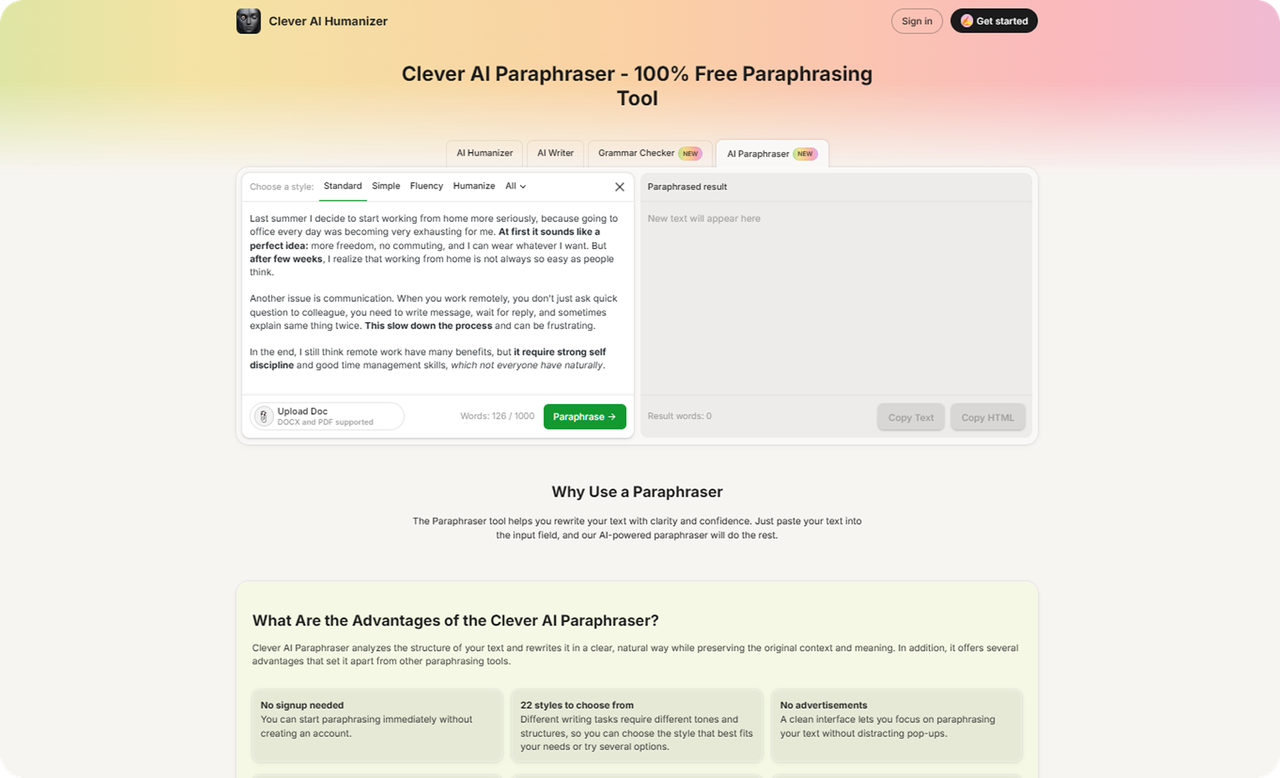
A memory-based draft removes direct copying, but phrase-junction patterns absorbed from the source survive even careful rewrites. The most reliable way to clear them is a clause-level rewrite tool that works from semantic meaning, not surface wording – which is exactly what Clever AI Humanizer's paraphrase tool does. Use it to rephrase your cite source to avoid plagiarism at the structural level rather than the vocabulary level. Paste your drafted paragraph into the left input panel and select the processing mode. The tool handles up to 1,000 words per pass; registered users start with 7,000 words free. For longer drafts, split by section and process each block separately.
3. Select the Style Tab That Matches Your Context
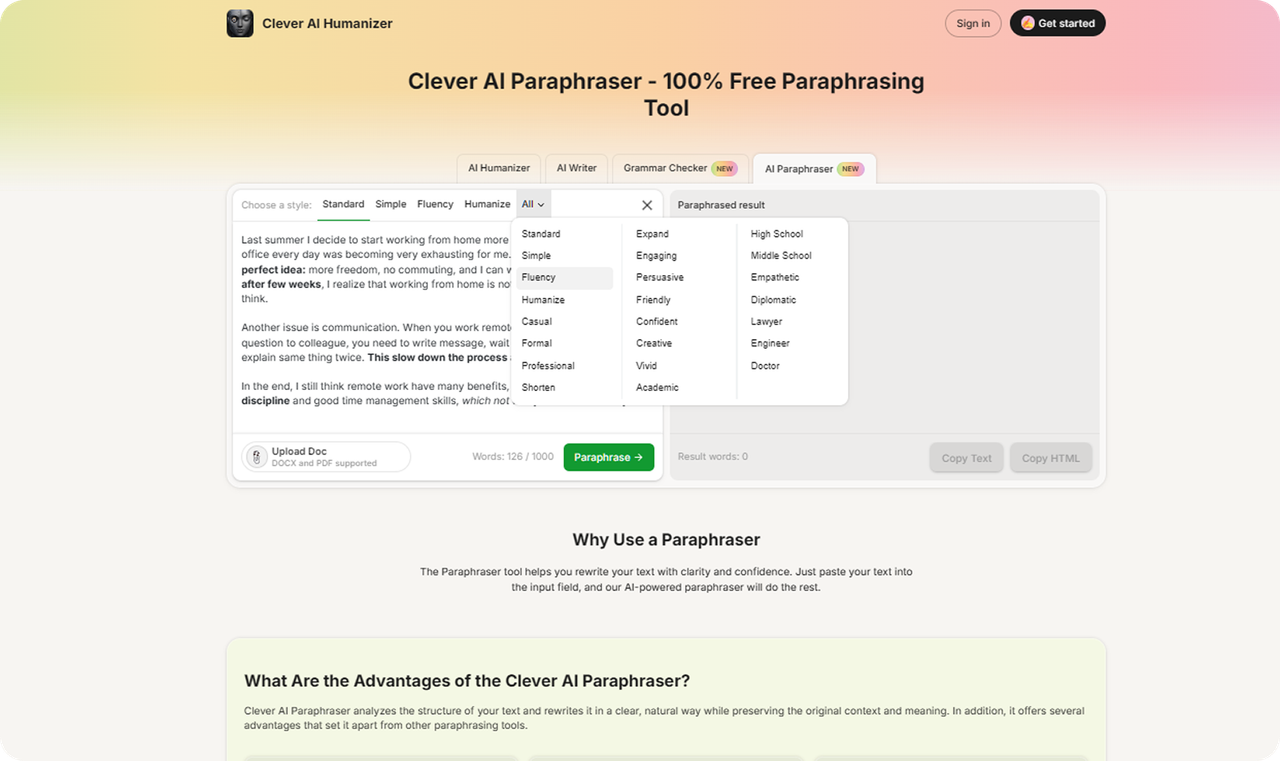
Four style tabs appear above the input panel: Standard, Simple, Fluency, and Humanize. For academic writing, select Fluency or Standard. Fluency varies in sentence length and clause entry points within each paragraph, which breaks the uniform rhythm that Turnitin's AI writing check flags as machine-generated text. Standard keeps the argument structure closer to your draft's original sequence and changes primarily the phrasing rather than the clause architecture – the better choice for technical or scientific papers where the logical order of claims must stay intact.
4. Review Every Highlighted Change in the Output Panel
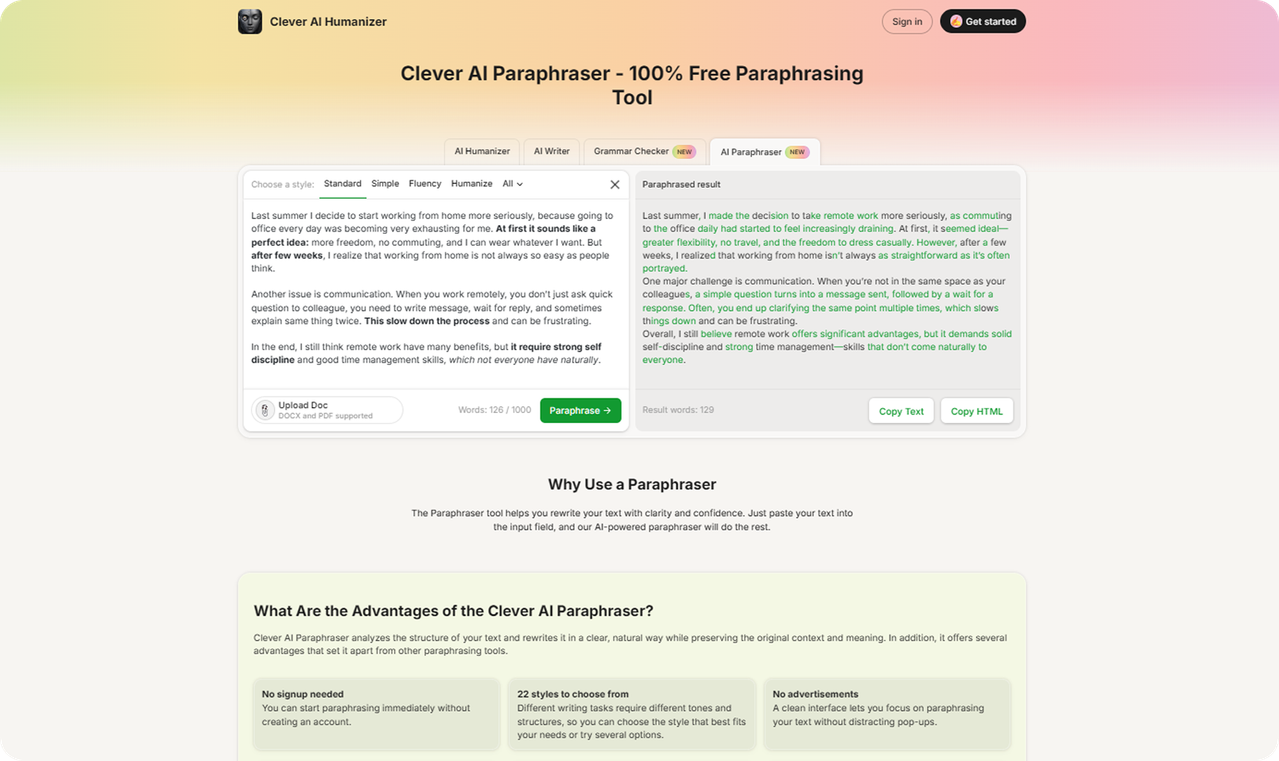
Click Paraphrase. Clever AI Humanizer works as a free AI humanizer to avoid plagiarism: it rewrites each paragraph from semantic meaning rather than from surface phrase structure, which is the distinction that moves Turnitin similarity scores after manual synonym replacement has already failed. The rewritten output appears in the right panel with every change highlighted in green. Read through each highlighted segment. Confirm that clause entry points differ from your draft and that no technical term was altered. Technical terms must stay verbatim. If any paragraph still mirrors the source frame, adjust the clause opening directly in the left panel and run the pass again on that section.
5. Place the In-text Citation at the Exact Idea Boundary
Before you copy the output, add the in-text citation at the last word of the sourced idea, before the period, before any independent transition sentence. In APA 7th, a paraphrase takes (Author, Year) and a direct quote takes (Author, Year, p. X). In MLA 9th, both a paraphrase and a direct quote take (Author Page) when the source has page numbers; for online sources without pagination, use (Author) only. Click the Copy Text button below the right panel to transfer the result to your document.
6. Run the Grammar Check as a Separate Pass
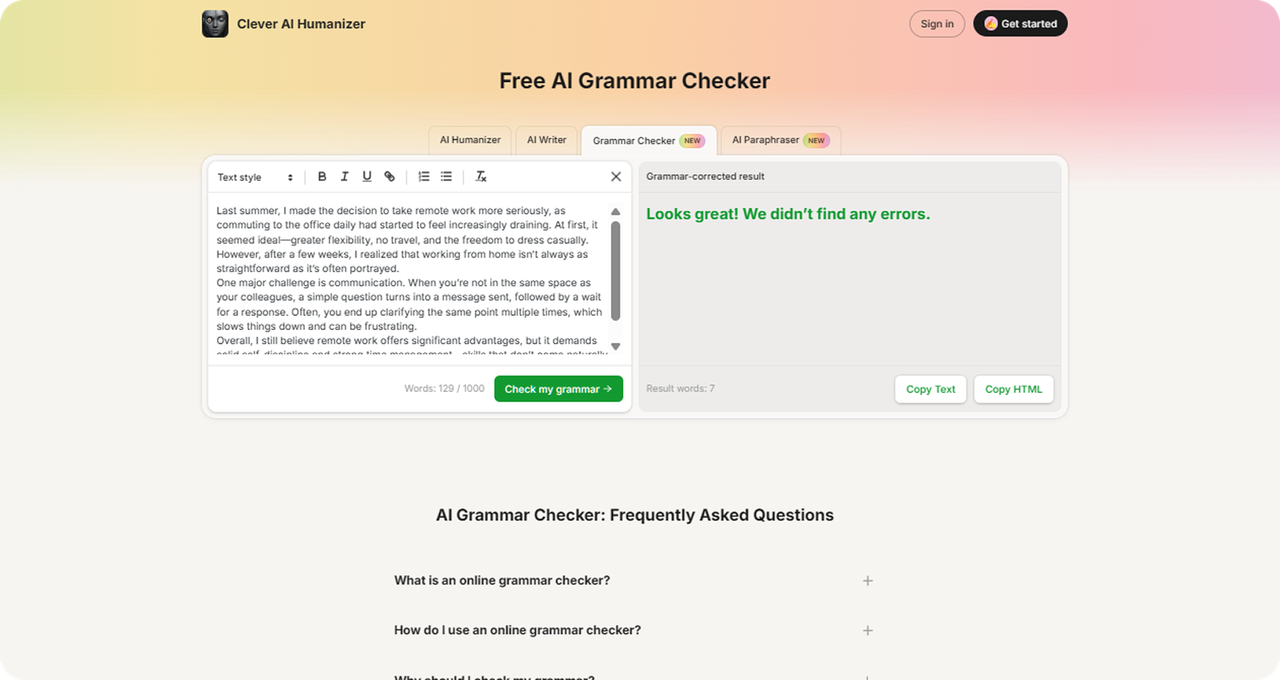
Open a fresh browser tab and use Clever AI Humanizer to check the grammar in your academic paper as a separate pass after the paraphrase step. Run it in a new tab rather than the same session: clause-level rewriting introduces agreement errors at paragraph joins, and a grammar check run immediately after paraphrasing flags the same text the paraphrase tool just changed, making it harder to identify which fixes belong to which pass. Paste the assembled text, click Check my grammar, and review each flagged item individually. Fix every flagged item before you run the similarity check.
7. Verify the Score on Two Checkers Before Submission
Run the full assembled paper through at least two checkers with different database scopes. Turnitin's academic misconduct research confirms that detection tools now report a similarity score and an AI writing score simultaneously. Both require independent clearance. A paper that passes the similarity threshold can still fail the AI check if sentence rhythm survived the rewrite. Turnitin itself sets no universal acceptable percentage – that threshold is institution-specific and often unpublished. Most undergraduate programmes use 15–25% as a review trigger; postgraduate and research submissions are evaluated at 10% or below, and journal submission systems commonly flag at 5%. Check your institution's academic integrity policy before submission. Any section above your institution's threshold returns to Step 2 for another pass.
What Plagiarism Is and What Properly Citing Sources Prevents
The seven steps above address the mechanics. This section addresses the boundary: what counts as plagiarism, why citation is the line that separates attributed use from a violation, and which format your institution is likely to require.
Academic plagiarism means presenting another person's ideas, words, or argument structure as your own without attribution. It covers direct copying, paraphrasing without a citation, mosaic construction from multiple sources assembled in the original sequence, and self-plagiarism. Most institutions define the boundary the same way: if attribution is absent or misplaced, the submission fails the integrity check regardless of how much the wording was changed.
Citation is what separates attributed use from plagiarism. The format varies by style. The placement rule does not: the citation mark belongs at the point where the sourced idea ends – before your own transition sentence begins, never after. The three styles most institutions require:
- APA 7th – behavioral and social sciences, education, nursing, and communications. Paraphrase: (Smith, 2021). Direct quote: (Smith, 2021, p. 44).
- MLA 9th – humanities. Paraphrase and direct quote both use the author and page number: (Smith 44). If the source has no page numbers, use the author name only: (Smith). The Works Cited entry groups the source within its publication container.
- Chicago (17th or 18th ed.) – history and arts. A superscript footnote number in the text maps to a full bibliographic entry in the notes section, with an optional bibliography at the end. The 17th edition (2017) remains widely used; the 18th edition (2024) added AI citation guidance and updated online source formats. Check which edition your institution currently requires.
Confirm the required style before you collect any sources. A style switch after the draft forces a full reference list rebuild, which is where most formatting errors enter a paper. What that data collection looks like in practice differs by paper type – the next section covers the two most distinct formats.
How to Cite Sources for a Research Paper and a Scientific Paper
Citation format requirements differ between disciplines and paper types. To properly cite sources in academic writing, you need to match the style your institution requires to the source type you reference. Research papers in the social sciences, education, and humanities follow author-date or author-page styles. Science papers in the biomedical and chemistry fields use numbered styles. The two subsections below cover each context separately, because the errors they produce differ and the fixes are not interchangeable. Apply the right format from the start, and you reduce plagiarism flags that originate from format validation rather than from the attribution errors covered in the steps above.
Research Papers – Author-Date Styles
Record full citation data at the moment of reading: author name, publication year, article title, journal or publisher, volume and issue where applicable, page range, and DOI or URL. When you reconstruct this data after the draft, you produce page number errors, misspell author names, and pull incorrect publication years. Each error fails the format validation pass. For a paper with multiple source types, every in-text citation must match a reference list entry exactly. An in-text citation with no corresponding reference list entry fails the completeness check.
Scientific Papers – Numbered Citation Styles
Science papers most commonly use Vancouver in biomedical fields, ACS in chemistry, and IEEE in engineering and computer science. Each source receives a number when first cited in the text, inserted as a superscript or in square brackets. That number appears in every subsequent reference to the same source. The reference list orders entries by citation number, not alphabetically. No author name appears in the in-text position. If your programme uses APA in a science context, the author-date rules apply identically. Confirm the required format with your instructor before you structure the reference list.
Getting the format right removes one category of flags. The patterns below address a different category – the structural and attribution habits that produce flags regardless of which citation style you use.
Tips to Avoid Plagiarism in Essays and Academic Papers
The four patterns below account for the majority of plagiarism flags in student submissions, across essay types and degree levels. Each targets a different stage of the writing process. None requires a tool to fix. They are discipline problems, not software problems – and plagiarism prevention at this level is easier to apply when you know exactly which stage each one addresses.
Change the Argument Sequence, Not Just the Words
Mosaic plagiarism occurs when correctly paraphrased sentences appear in the same order as the source: claim, then evidence, then conclusion, in the original paragraph sequence. The detector identifies argument sequences at the paragraph level. Present evidence before the main claim in at least two body paragraphs. Group sub-points differently from the source order. A reader familiar with the original should not predict which sentence comes next in your version.
Add Citation Placeholders During the Draft, Not After
Attribution data becomes hard to place accurately after the draft is complete. You lose track of where the paraphrased idea ended and where your own transition began. Add citation placeholders at the exact sentence where each sourced idea ends as you write. This produces correct placement and prevents the most common single source of attribution flags in otherwise well-written academic papers.
Hold Technical Terms Verbatim in Every Paraphrase
Technical terms, domain-specific vocabulary, and statistical labels must stay unchanged in paraphrased content. A substitution like "operationalization" for "measurement" distorts academic meaning. Checkers flag clause architecture and phrase junctions, not subject-matter vocabulary. Rewrite the framing language and transitions around technical terms. The terms themselves stay as they are in the source.
Verify Each Reference List Entry Before You Submit
A missing DOI, incorrect year, or wrong author format each produces a separate citation error in the format validation pass. Before submission, cross-check every in-text citation against its reference list entry: author name, publication year, and DOI. This check takes five minutes and removes a category of errors that has no other cause than incomplete data entry at the moment of reading.
FAQ
Is it plagiarism if you cite correctly
No. A correctly formatted in-text citation placed at the boundary of the paraphrased idea, matched by a complete reference list entry, fulfills the attribution obligation. A citation placed after a transition sentence rather than at the paraphrase boundary still produces a flag, because the paraphrased block reads as unsourced to the detector. Correct format and correct placement are both required.
What is academic plagiarism?
Academic institutions define plagiarism as the use of another person's ideas, words, or argument structure in submitted work without proper attribution. The category covers four distinct acts: direct copying, paraphrasing without a citation, mosaic construction from multiple sources in the original sequence, and self-plagiarism. Most honour codes treat all four identically at the point of enforcement: a failed integrity check with the same consequences as deliberate copying, regardless of intent.
How do you cite a source in an essay?
The format depends on the style your course requires. In APA 7th: a paraphrase takes (Smith, 2021) and a direct quote adds the page number: (Smith, 2021, p. 44). In MLA 9th: both a paraphrase and a direct quote use the author and page number together: (Smith 44). For online sources without page numbers in MLA, the author name alone suffices: (Smith). In Chicago notes style, a superscript footnote number sits at the citation point, and the full source details go in the corresponding footnote. Across all three styles, the citation belongs at the end of the sourced idea, not after the transition sentence that follows it.
How do you avoid plagiarism when you paraphrase
Close the source before you draft. Write the idea from your notes in your own clause order. Run the draft through a clause-level paraphrase tool to clear phrase-junction patterns. Add the in-text citation at the idea boundary. Verify the similarity score and the AI writing score on two checkers before submission. Correct placement and clause-level rewriting remove the highest proportion of flags.
What are the ways to avoid plagiarism when you reuse your own previous work?
Disclose the previous submission to your instructor before you begin. Cite your earlier paper as a source with the same in-text and reference list format you apply to any other source. Turnitin checks submissions against previous student papers, including your own, so undisclosed reuse returns a similarity flag regardless of whether the original work received a grade.
How do you cite sources for a research paper with no author?
Use the title in the in-text citation in place of the author name. In APA 7th, a shortened title in double quotation marks for an article or in italics for a book, followed by the year: ("Citation Guide," 2023). In MLA 9th, the title or a shortened version is in the parenthetical: (Citation Guide 12). In Chicago notes, the title appears in the footnote where the author's name would normally go.
The questions above cover the most common citation decisions. Two points that rarely appear in standard citation guides are worth stating separately.
Conclusion
One detail that does not appear elsewhere in this guide: citation errors compound across a paper. A single misplaced citation in paragraph three shifts every reader's expectation of where attribution will appear in paragraphs four through ten. Professors who read dozens of papers in a field develop a calibrated sense of where sourced material begins and ends. A placement pattern that works once may get caught later in the same paper precisely because the first error set a different expectation. Correct placement from the first sourced paragraph matters more than most students realise.
A second point worth stating directly: similarity thresholds are institution-specific, not universal. Turnitin publishes no acceptable percentage of its own. Most undergraduate programmes treat 15–25% as a manual review trigger; postgraduate submissions are evaluated at 10% or below; journal systems commonly flag at 5%. Whatever threshold your programme uses, treat it as a ceiling, not a target. The workflow in this guide produces scores well below common thresholds when followed in sequence – but only if the grammar pass comes after the clause-level rewrite, not before, and if the two-checker verification uses databases with different scopes.
Finally, citation format is not static. APA 7th replaced APA 6th in October 2019 and changed how group authors, DOIs, and edition numbers are formatted. MLA 9th replaced MLA 8th in April 2021 and expanded its container model for digital and database sources. Chicago 17th (2017) revised footnote formats for online materials; Chicago 18th (2024) added official AI citation guidance and is already adopted by many institutions. If your institution specifies a style without specifying an edition, confirm the edition before you structure the reference list. An outdated format produces the same validation error as a wrong author name – and it is just as avoidable.